
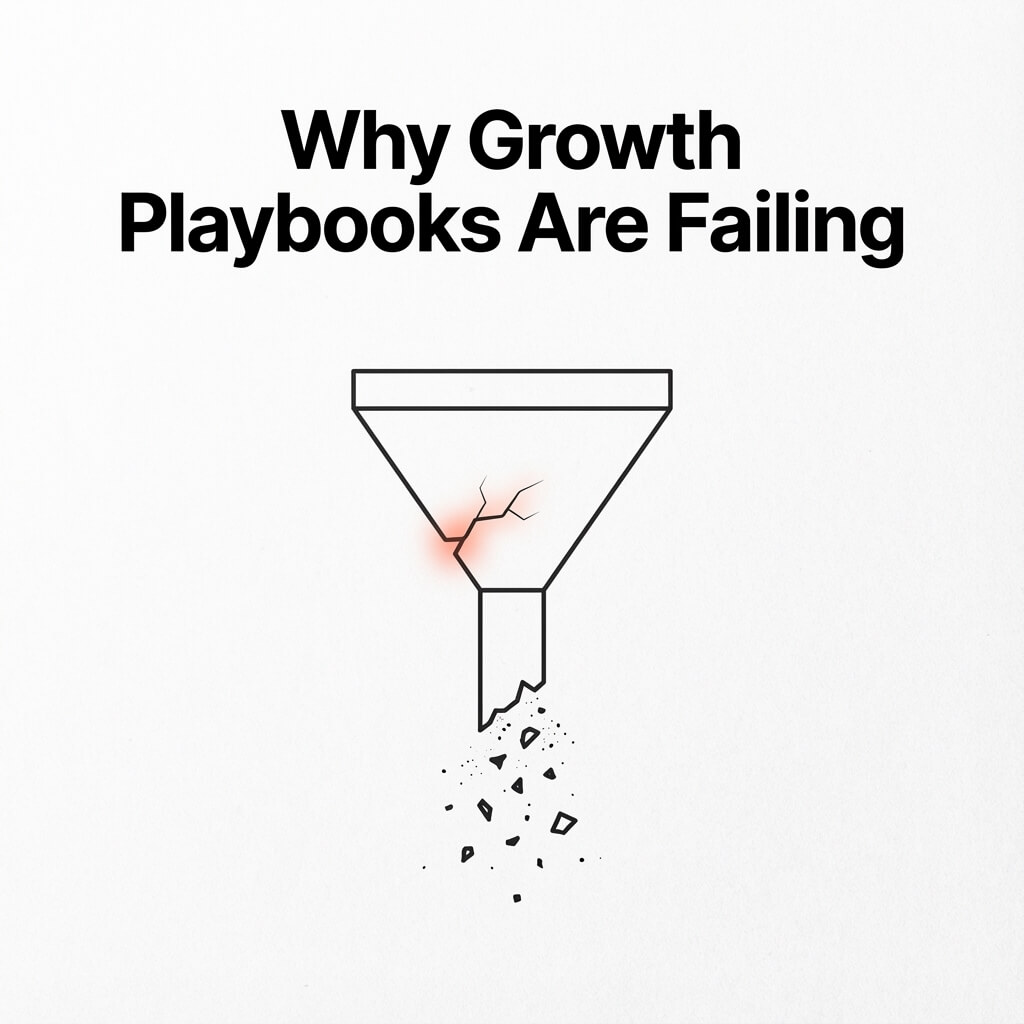
Growth has always been about distribution. Not just product. Not just marketing. Distribution. And today, distribution is changing fast. Search is turning into “answers,” social platforms are squeezing links, and AI is making it easier for customers to copy features. So the old playbooks (funnels, SEO hacks, paid growth scaling forever) break. What replaces them is loops, velocity, data moats, ecosystems, and brand built through the product itself.
What Does “growth” Really Mean in 2026?
Growth means you can reliably get your product in front of the right people, again and again, without your cost exploding.
In practice, that means distribution that doesn’t collapse when:
- Google adds an AI summary.
- LinkedIn throttles outbound links.
- A new channel gets saturated.
- A competitor clones your “basic features” in a weekend.
This is why “growth” is now a product problem and a distribution problem at the same time.
Why are Growth Playbooks Crumbling Right Now?
Because the “pipes” we depended on are brittle.
1) AI search creates more zero-click behavior
Even before AI Overviews, Google was already a zero-click machine. SparkToro + Datos found that in the US, 58.5% of Google searches end without a click (EU: 59.7%). That means more than half of the time, people don’t visit any site at all
Now layer AI Overviews on top.
Pew’s browsing-data study (68,879 searches) found that when an AI summary appears, people click links less:
- 8% clicked any traditional result (vs 15% when no AI summary appeared)
- only 1% clicked a source link inside the AI summary
- 26% ended browsing entirely after seeing an AI summary (vs 16% without)
Ahrefs also measured a major CTR drop: on informational keywords, AI Overviews correlate with a 34.5% lower CTR for the #1 organic result.
So the pattern is consistent: more answers, fewer clicks.
2) Social platforms increasingly punish external links
This matters because “distribution” isn’t only Google. Social was the backup plan. But social wants people to stay in-app.
When platforms downrank links, “post → click → site visit” gets weaker. That pushes you toward in-platform loops (creators, community, product sharing) instead of link-based traffic.
3) Customers can rebuild “good enough” versions
When building becomes cheaper, “features” become less defensible. The Lovable + DocuSign clone story makes that real: a free alternative was built quickly, then DocuSign sent a legal threat.
This is the new fear: not just competitors. Users.
What’s the Difference Between a Funnel and a Loop?
A funnel is a one-way pipe:
- Acquire
- Activate
- Convert
- Retain
…and the story ends.
A loop is a self-reinforcing system:
- Input enters the product
- Product creates an output
- Output gets reinvested
- That reinvestment generates new input
…and the story repeats.
Funnels optimize conversion.
Loops create compounding.
What are Modern Growth Loops— and How do They Work?
Let me explain that with two examples.
Loop #1: Calendly — “invites create new users” loop
What is the loop in one sentence?
Each meeting scheduled becomes a product demo to a new person, which creates the next user, which creates the next meeting.
Input → what starts the loop?
A user needs to schedule time with someone.
Action → what happens inside the product?
They send a Calendly link instead of emailing back-and-forth.
Output → what is produced?
The invitee experiences the product before becoming a user:
- sees time slots
- books instantly
- gets reminders
- feels the “wow” of no friction
Reinvestment → how does output create new input?
The invitee thinks: “I want this too.”
They create an account and start sending links.
That turns recipients into senders.
Why this beats a funnel
A funnel depends on buying traffic and pushing prospects through steps. Calendly’s loop turns usage into distribution.
And AI search doesn’t break it, because the channel isn’t “rank on Google.” The channel is the meeting itself.
How to copy the loop
If you’re building B2B SaaS, ask:
- What user action naturally “touches” a non-user?
- Can the non-user get value without signing up?
- Can you make the non-user’s first exposure feel like the product solved a real problem?
Loop #2: Canva — “creation → sharing → new creators” loop
What is the loop in one sentence?
People create things in Canva, share them everywhere, and every shared asset markets Canva to the next user.
Input → what starts the loop?
A person needs a design (deck, poster, social post, resume).
Action → what happens inside the product?
They use templates and simple tools to create something they’re proud of.
Output → what is produced?
A finished asset that is made to be shared:
- exported
- published
- presented
- collaborated on
Reinvestment → how does output create new input?
That asset travels:
- coworkers ask, “Where did you make that?”
- teams share editable links
- templates get reused
- collaboration pulls more people into the same workspace
So distribution is embedded in the workflow.
Proof that Canva treats product as distribution
Canva publicly positions itself around collaboration and teams, not just “design.”
Canva’s enterprise credibility is also reinforced through major customer stories.
Why this beats a funnel
A funnel tries to convince you with pages. Canva convinces you with outcomes. The output is the ad.
How to copy the loop
Ask:
- Can users produce an output others can see?
- Can sharing preserve product branding without being spammy?
- Can collaboration require inviting teammates (without feeling forced)?
Why did Product-Led Growth (PLG) become a big deal?
PLG didn’t “win” because founders loved freemium.
PLG became big because the market changed.
1) Why did users start becoming buyers?
People at work started choosing tools themselves. They didn’t wait for procurement. They just started using the product. This is linked to “shadow IT” and self-serve SaaS behavior (tools adopted bottom-up).
Once users can start without permission, the product becomes the top of the funnel.
2) Why did channels get shorter-lived?
Marketing channels get saturated faster now. That’s not a moral issue. It’s math: more competition, higher CAC, diminishing returns. So companies leaned into PLG because it reduces dependency on “renting attention.”
3) Why did data make PLG stronger?
Modern SaaS can see the full journey: activation, retention, feature usage, expansion, churn signals. When you can measure it, you can improve it. That pushes growth inside the product.
4) Why did roles blur (product, marketing, growth)?
In PLG, growth isn’t “a campaign.” It’s onboarding, collaboration mechanics, pricing, packaging, and retention. That forces cross-functional teams.
What Happens to SEO-dependent Businesses in an AI-Answer World?
If your business model depends on ranking for informational queries and capturing clicks, you have three problems:
Problem 1: Your “top of funnel” gets eaten by summaries
When CTR for #1 drops by ~34.5% on keywords with AI Overviews, you’re fighting for a smaller pie.
Problem 2: Even citations don’t guarantee traffic
Pew found only ~1% of people click a source link in AI summaries. That means “being cited” may build authority, but it’s not a traffic strategy by itself.
Problem 3: Zero-click was already high, AI just accelerates it
If ~58.5% of searches already end without clicks, AI Overviews push even more queries into “no visit needed.”
What does this mean in simple business terms?
Traffic becomes less predictable. Growth playbooks based on “publish more SEO pages” stop compounding.
So SEO-dependent companies must shift from:
- “ranking pages”
to: - being the product people talk about
- building loops
- earning direct demand
- showing up inside answer engines
So What Replaces Old Growth Playbooks?
This is the new menu. Not “one trick.” A system.
1) Product as the marketing channel
If the product creates its own distribution (Calendly invites, Canva sharing), your growth survives channel shocks.
2) Loops instead of funnels
Loops compound because outputs become inputs. Funnels don’t. That’s why loops are the strategy layer now.
3) Velocity as a moat
In an AI world, shipping speed is leverage. Small teams can move faster, test more, iterate more. Velocity becomes defensibility because the market moves too fast for slow orgs.
4) Data as stickiness (but not “data for data’s sake”)
Data matters when it improves the experience: personalization, better results, better recommendations, better workflows.
Also: platforms can restrict data access and change the rules, which shifts power. (Example: Slack ecosystem data access restrictions impacting third parties like Glean.)
5) Brand as a product function
Brand is no longer just marketing. Brand is what people remember when they stop clicking links and start asking an AI.
In an answer-engine world, brand becomes a retrieval shortcut.
6) Ecosystems and integrations as distribution
Marketplaces and integration directories can become durable acquisition surfaces, because they’re closer to workflow than ads. Example: Slack’s distribution via the Slack Marketplace.
7) Prepare for “app stores inside AI”
Google is building AI Mode, and OpenAI is building a platform layer (GPT Store). These are new distribution shelves.
In 2026, the new growth playbook is simple: build loops, earn distribution, and ship faster than the channel can change.
11 Lessons From Analyzing 1,000+ High-Converting Landing Pages
Here I am explaining, my observations and learning around what actually works after building 100+…
Guide to Local SEO & AEO: Why Your Agency Might Be Optimising the Wrong Things
Local SEO & AEO are no longer optional for businesses that depend on local customers…
Why ‘Owning Nothing’ is a Trap, and How It’s Making You Poorer
The Owning Nothing Economy is slowly becoming normal, and most of us don’t even realise…
Somatic Markers (Part 2): How Feelings, UX, and Context Drive Buying Choices
In the last article, we talked about somatic markers — in simple words, these are…
How to Rank #1 in AI Overviews & Answers: AEO & GEO Guide
We learned SEO. We learned keywords. We learned backlinks. And for a while, that worked….
11 AI Tools For A Digital Nomad’s Workflow
As a freelance growth marketer and a digital nomad, my workflow is my lifeline. Last…