

In the last article, we talked about somatic markers — in simple words, these are emotional and body-based memories created from past experiences. They work like invisible shortcuts. They quietly push your hand towards one option and away from another.
But that was only the beginning.
The more interesting questions are harder:
- Does my “gut feeling” work the same way as yours?
- If a brand creates a good feeling today, will it stay after one year?
- How do these body-based feelings even work on a mobile screen where nothing is physical?
- And the uncomfortable question: If we understand this system, where is the ethical line?
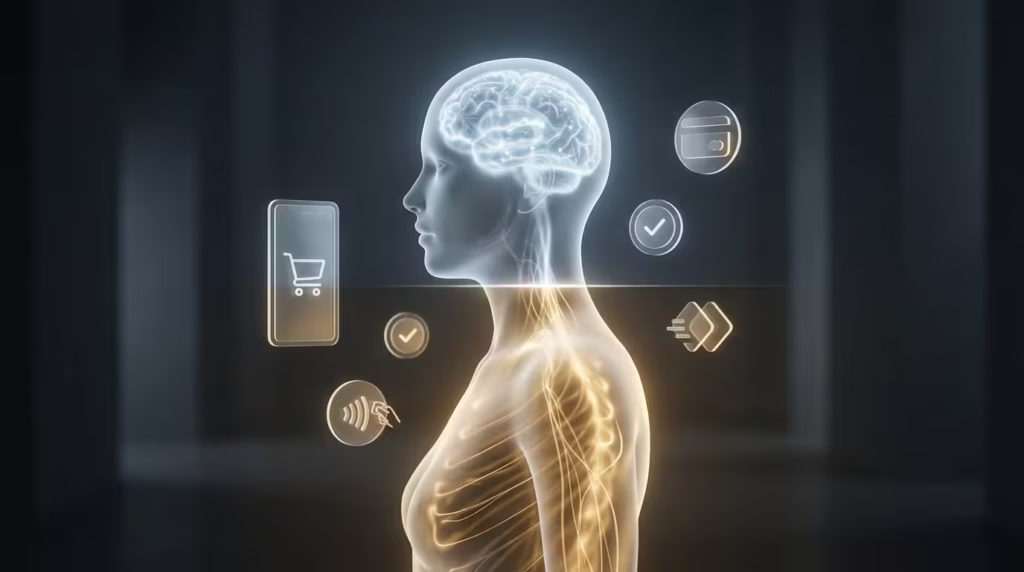
In this deep dive, we will dissect the complex, dynamic, and sometimes paradoxical nature of somatic markers. We will move beyond the simple stimulus-response model and explore the nuances that separate good marketers from true masters of consumer psychology — but in a simple way.
The Somatic Self: Why Your Gut Feeling Is Not the Same as Mine
One of the most significant leaps in understanding somatic markers is recognizing that they are not a one-size-fits-all phenomenon. This isn’t just a matter of preference; it’s rooted in our individual neurobiology and psychology.
One big mistake we make in marketing is assuming:
“If this feels good to me, it will feel good to everyone.”
That’s not true.
Somatic markers are not universal. The same ad, the same website, the same message can create:
- Comfort in one person
- Stress in another
- Excitement in a third person
Why?
Because people feel their bodies differently.
There is a scientific term for this: interoception.
In simple words, it means:
How clearly you can feel what is happening inside your body.
Some individuals have high interoceptive awareness—they are finely tuned to their body’s signals. Others are less so. This difference is critical. A consumer with high interoceptive accuracy is likely to experience somatic markers more vividly and be more influenced by them.
In simple terms, we can say that :
- A “Limited time offer! Only 3 left!” message:
- Makes one person excited
- Makes another person stressed and uncomfortable
So for the first person, somatic markers are louder.
So the same marketing trick:
Can create a positive somatic marker in one group
And a negative somatic marker in another group.
This is why some brands feel:
- “Nice and premium” to one person
- “Too pushy and stressful” to another
The Advanced Application: Somatic Personalization
This idea takes us beyond normal “sensory marketing” into something more practical and more powerful: somatic personalisation. In simple words, instead of showing the same experience to everyone, we try to match the experience to how different people feel inside.
We can’t directly measure how sensitive someone is to their body signals. But we can guess from their behaviour.
For example, some people always click on things that talk about safety, guarantees, and security. They want to avoid mistakes. Their body reacts strongly to risk and uncertainty. Other people click more on things that talk about new features, upgrades, and new possibilities. They enjoy trying new things and are less scared of uncertainty.
These two types of people are not thinking differently. Their bodies are reacting differently.
Modern apps and websites already collect enough data to notice these patterns. With AI and machine learning, it is possible to slowly adjust what a person sees — the words, the layout, even the email subject lines — so that it matches what their nervous system is more comfortable with.
In the future, good marketing will not just personalise what we show. It will personalise how it feels.
The Ghost in the Machine: Somatic Markers in a Digital World
A lot of people think somatic markers only make sense in the physical world. They ask a simple question: How can a body feeling come from a screen? It’s just pixels, right?
But the brain doesn’t work like that.
The brain is very good at pretending.
When you remember a past moment, your body is not actually there. But your brain can still create the same kind of feeling. It runs a small simulation. Scientists call this the “as-if body loop”. In simple words, the brain says: “Let me recreate how this would feel, even if it’s not really happening.”
This is the key to understanding somatic markers in e-commerce and digital marketing. Every element of your user experience is creating these “as-if” markers. A 2020 study on e-retail confirmed the critical role of these markers in online brand selection.1
- Digital Haptics: The subtle vibration of your phone confirming a successful payment is a positive somatic marker of completion and security.
- •Micro-interactions: The smooth, satisfying animation when you “like” a post on social media, or the frustrating, jerky loading icon on a slow website, are all generating micro-markers that accumulate over time.
- •Sound Design: The crisp “swoosh” of a sent email or the jarring error sound of a failed login attempt are auditory triggers for the as-if body loop.
Your website, your app, your checkout flow — all of them are creating small body-feelings all the time, even if the user doesn’t notice it consciously. In fact, studies have already shown that these “as-if” feelings play a big role in which brand people choose online.
All these are not big experiences. They are small, tiny somatic markers.
But over time, they add up.
And slowly, without the user realising it, the body starts to decide:
“This app feels good.”
“This website feels stressful.”
“This brand feels safe.”
“This one feels annoying.”
Long before logic comes in.
The Advanced Application: The Digital Somatic Audit
Expert marketers must now become architects of these digital somatic experiences. This requires conducting a digital somatic audit.
Go through your entire online customer journey, from the first ad impression to the post-purchase email, and ask: What is the feeling at each step? Is the experience smooth, rewarding, and confidence-inspiring, creating a cascade of positive as-if markers? Or is it filled with friction, uncertainty, and frustration, creating negative markers that build a subconscious aversion to your brand?
This isn’t just about aesthetics; it’s about engineering a digital environment that feels good on a deep, neurobiological level.
Why Feelings Change Over Time (Context, Decay, and the Non-Linear Journey)
One big mistake we make is thinking that a somatic marker is something permanent. Like once a person likes a brand, that feeling will stay forever.
That’s not how it works.
A somatic marker is more like an echo. It slowly becomes weaker. And it also changes depending on what happens next and what situation the person is in.
Real life decisions don’t happen in a straight line.
Research into non-linear decision chains has shown that the sequence of experiences matters immensely.2
A customer’s journey is not a set of separate events. It’s one long chain of experiences. And here is the dangerous part: a few small bad experiences can destroy one big good experience.
Imagine this:
- The product is actually great.
- But the website loads slowly.
- The checkout is confusing.
- The confirmation email comes late.
Nothing here is a “big problem”. But together, they create a bad feeling. And that bad feeling can overwrite the good feeling created by the product itself.
In the end, the body does not remember just the best moment. It remembers the whole journey.
That ad that felt inspiring and aspirational in a calm moment can feel irritating and out-of-touch when viewed during a stressful commute.
So somatic markers don’t live in isolation. They live inside a moving, changing body.
What This Means: Somatic Journey Mapping
Because of this, we should stop thinking only in terms of:
“What action do we want the customer to take here?”
And start thinking:
“How do we want the customer to feel at this point?”
This is the idea of somatic journey mapping.
For every step — ad, website, signup, checkout, email, support — we should ask:
Is this calming or stressful?
Is this simple or mentally tiring?
Is this reassuring or confusing?
A very simple example: is your mobile checkout easy enough that a busy parent can finish it without stress? Or does it add one more headache to an already tired brain?
The same goes for physical spaces. Is your store calm? Or is it noisy and overwhelming without you realising it?
And one more important thing: good feelings fade.
So good brands don’t just create a nice first experience. They refresh it again and again before the old good feeling disappears.
The Marketer’s Dilemma: The Ethics of the Gut
Once we understand how gut feelings work, we also get the power to misuse them.
We can create trust. But we can also create fear.
We can make things feel safe. But we can also make people anxious on purpose.
That’s where the real responsibility comes in.
Good marketing should use these ideas to make products and experiences simpler, clearer, and more human — not to trick people into decisions they will regret later. Brands built on real, positive feelings grow slowly but last long. Brands built on fear and pressure may grow fast, but people don’t trust them for long.
Somatic markers remind us of one simple truth: behind every click and every purchase is a real human body and mind.
Earlier marketers did this by instinct. The next generation will do it on purpose — by designing experiences that don’t just look good, but feel right.
References
- Ojha, S. C. (2020). Role of somatic markers in consumer durable brand selection in e-retail. International Journal of Business Forecasting and Marketing Intelligence, 6(2), 125-140. ↩︎
- Bedia, M. G., & Fisas, I. (2012). The somatic marker hypothesis in non-linear decision chains. Frontiers in Psychology, 3, 384. ↩︎
[…] Fo reading more on Somatic Markers & Buying Behaviours, check here. […]