
Local SEO & AEO are no longer optional for businesses that depend on local customers — but most agencies are still using an outdated version of both. This comprehensive guide willteach you everything you need for 2026 Local SEO & Answer Engine Optimisation (AEO) win.
Let me ask you something.
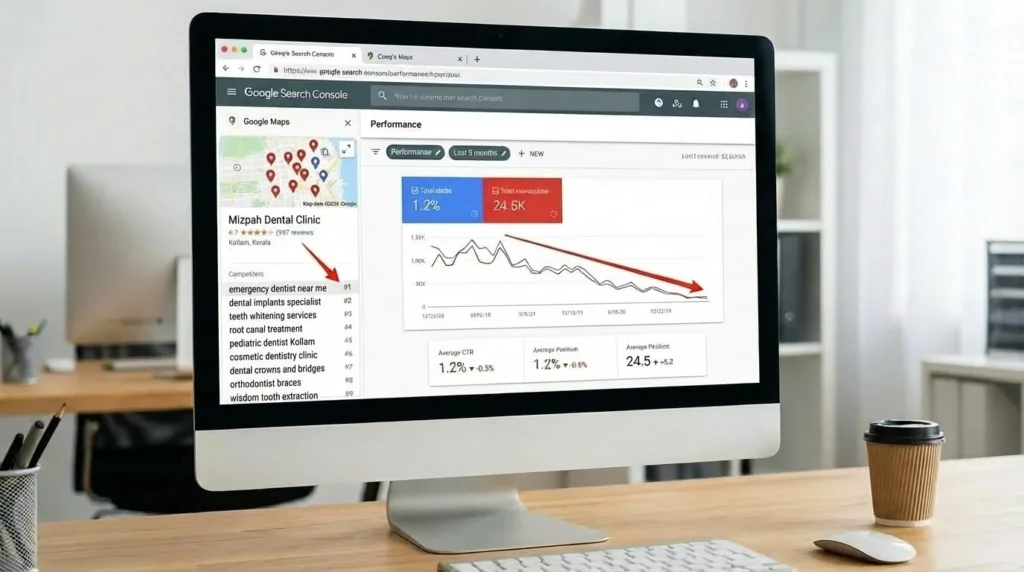
If your business website is getting 50,000 visitors every month, but your phone is not ringing — is that success?
I recently reviewed a top hospital’s website performance. They were spending close to ₹3–4 lakh per month on digtal marketing. Traffic looked impressive. Thousands of visitors. Beautiful reports. Growth charts going up.
But wy they reached out to me? Because of the leads, and its quality. Conversions? Almost none.
In my Analysis, I understand most of the traffic was coming from other cities. Some even from outside India. People reading blog posts. Not people booking appointments. That’s when it becomes clear.
Traffic is not the same as demand.
For years, local SEO meant one thing: publish blogs, rank for keywords, increase website visitors. Agencies still follow that playbook. Weekly blogs. Generic articles. National-level keywords, & a Google Business Profile.
The game has changed. It’s no longer just about local SEO; it’s about Answer Engine Optimization (AEO). It’s about being the definitive answer not just on Google, but on AI platforms like ChatGPT. In this guide, I’m going to break down the exact system we use to dominate local search and get our clients recommended by AI, turning their online presence from a cost center into a lead-generation machine.
Why Is Your Current Local SEO Strategy Failing?
Let’s get straight to the point. The fundamental mistake that 99% of agencies make is that they focus on ranking the website. They chase vanity metrics like total traffic, creating blog posts about “how to fix a leaky faucet” that attract a national audience of DIYers instead of local customers ready to pay for your service.
This is national SEO, and for a local business, it’s a colossal waste of money. Every single piece of your online presence—every page on your website, every review, every citation—should have one singular goal: to make your Google Business Profile (GBP) the undeniable authority for your service in your location. This is the core principle of modern local SEO and AEO.
How to Fix Your Local SEO Strategy
The Only Metric That Matters: Google Map Pack Rankings
When someone in your city searches for “dentist near me” or “AC repair in Yelahanka,” what appears first?
Not your blog OR your homepage.
They see the Google Map Pack — the top three local listings with ratings, reviews and call buttons. And most users don’t scroll beyond that.
If your business is not inside that map section, your organic ranking below it doesn’t carry the same weight. Even if you rank #1 on the website results, you are competing for much less attention.
For local businesses, this is the real metric that matters: Are you in the top three map results?
Everything else is secondary.
The 5-Step AI-Aligned Workflow to Improve Map Pack Rankings
This is the structured process I follow when analysing local businesses in India, it’s not a hack. Just aligning your business with what Google actually evaluates for local authority.
Step 1: Treat Your Google Business Profile as Your Real Homepage
Before you optimise your website, optimise your Google Business Profile (GBP).
For a local business, your GBP often drives more direct actions than your website.
Calls.
Directions.
Bookings.
If this foundation is weak, nothing else will compensate.
Priority 1: Choose the Right Primary Category (Difficulty: Easy | Impact: Very High)
Your primary category is the strongest signal you send to Google. Be specific.
If you are a “Dermatologist,” don’t select “Skin Care Clinic.”
If you repair air conditioners, choose “Air Conditioning Repair Service,” not “Appliance Store.”
This one decision influences which searches you are eligible to appear for.
Many businesses get this wrong.
Priority 2: Add 4–5 Relevant Secondary Categories (Difficulty: Easy | Impact: High)
Most businesses stop at one category. That limits visibility.
Google allows multiple categories. Use them strategically.
For example:
An AC repair business can also add:
- HVAC Contractor
- Air Duct Cleaning Service
- Heating Repair Service
A dental clinic may add:
- Cosmetic Dentist
- Dental Implants Provider
- Emergency Dental Service
This expands the range of relevant searches where your profile can appear.
Quick Method to Check Competitor Categories:
Get the Phantom Chrome extension and add it to your browser. Search Google or Google Maps for your competitor’s business or your target keyword. The extension shows all categories any business uses in their profile automatically. Simple way to see what categories competitors rank with.
Priority 3: Complete Every Profile Detail (Difficulty: Easy | Impact: High)
An incomplete profile signals low seriousness.
Fill out:
- Business description
- Services
- Products (if applicable)
- Photos (real images, not stock)
- Posts
- Q&A section
- Attributes (wheelchair access, women-led, etc.)
- Booking links
- Website URL
Google rewards clarity and completeness. And customers trust profiles that look active and real.
Priority 4: Ensure Perfect NAP Consistency (Difficulty: Medium | Impact: High)
NAP = Name, Address, Phone number.
Your business details must be identical everywhere online. Not slightly similar. Must be exactly as it is.
“MG Road” vs “M.G. Road”
“Private Limited” vs “Pvt Ltd”
Even small inconsistencies can reduce trust signals in local search algorithms.
Audit your listings on:
- Justdial
- Quikr
- Sulekha
- IndiaMART
- Industry directories
Correct everything. Local SEO is about consistency.
Priority 5: Maintain Accurate Business Hours (Difficulty: Easy | Impact: Medium)
This sounds basic. But it matters.
Keep:
- Regular hours updated
- Holiday hours updated
- Emergency availability clear
Incorrect timings create poor user experience and negative engagement signals. Google tracks behaviour.
If users arrive and find you closed when the profile says open, it affects trust.
Priority 6: List 30+ Specific Services (Difficulty: Medium | Impact: Very High)
This is where many businesses under-optimise.
Don’t just list “Dental Services” or “AC Repair.”
Break it down.
For example, a dental clinic should list:
- Root Canal Treatment
- Teeth Whitening
- Wisdom Tooth Extraction
- Dental Implants
- Braces Consultation
An AC service provider should list:
- Split AC Installation
- Gas Refilling
- PCB Repair
- Water Leakage Fix
- Annual Maintenance Contract
The more specific you are, the more relevant you become for long-tail searches. This is also where AEO comes in. AI systems prefer structured clarity.
When someone asks, “Who does root canal treatment near me?” your profile should clearly indicate that you do.
Specificity improves visibility.
Step 2: Build the “Core 30” Website Structure
Once your Google Business Profile is properly optimised, your website must support it. Your website should not operate independently from your GBP. It should reinforce it.
This is where most agencies go wrong. They publish random blog posts hoping something ranks. Instead, you need a structured system. I call this the “Core 30” structure — a practical framework designed to build strong topical depth and clear local relevance.
What Are the “Core 30” Pages?
The Core 30 is a structured local SEO website framework.
It is not blogging or a content marketing technique.
It is a deliberate structure of approximately 30 pages designed to:
• Strengthen Google Map Pack rankings
• Improve local search visibility
• Increase AEO compatibility
• Build topical + geographical authority
Let me break it down.
The Core 30 Structure
1. Homepage (1 Page)
This is your main authority page. It must convey “Service + Location + Trust”.
Must include:
- Primary service + city in Title & H1
- Clear opening paragraph: The first 100 words should immediately reinforce this service + city combination
- Internal links to service hubs
Example:
“Orthopaedic Clinic in Kochi | Sports Injury & Joint Care”
2–6. Secondary Service Hub Pages (4–5 Pages)
Each secondary GBP category gets one page.
If you’re a dental clinic, for example:
- Cosmetic Dentistry
- Dental Implants
- Root Canal Treatment
- Orthodontics
- Emergency Dental Care
These pages:
- Target mid-level keywords
- Link down to specific service pages
- Strengthen topical depth
7–22. Service-Specific Pages (15 Pages Minimum)
This is where most businesses stop too early.
Every individual service listed in your GBP should have its own page.
For example, an AC repair business:
- Split AC Installation
- AC Gas Refilling
- AC PCB Repair
- Water Leakage Repair
- Annual Maintenance Contract
…
Continue until at least 15 specific services are covered.
Each page must include:
- Service + city in title
- 800–1,200 words
- Benefits
- Process
- Pricing (range)
- Neighbourhoods served
- Strong CTA
This builds hyper-specific search eligibility.
22–29. Location Reinforcement Pages (Optional but Powerful)
If you serve multiple neighbourhoods within your city, create:
Service in Kakkanad
Service in Edappally
Service in Kaloor
Not fake city pages. Real neighbourhood-level depth. This supports proximity signals.
30. Trust / Case Study Page
30. Detailed Case Studies or Success Stories
AI systems value proof.
Include:
- Real projects
- Before/after
- Testimonials
- Measurable results
This page strengthens AEO signals significantly.
Why 30?
Because:
1 page builds authority
5 pages build topical coverage
20 pages build specificity
Remaining pages build trust and location reinforcement
Total ≈ 30 pages
That’s enough depth to dominate most local competitors who are stuck at 8–10 pages.
The Internal Linking Hierarchy
When you have 30 pages (or 10+ depends on servcies), make sure its structure creates a perfect hierarchy that Google can easily understand. The homepage links to the secondary category pages. Each secondary category page then links down to all of its related service-specific pages. This creates a logical flow of authority and relevance.
For example:
Homepage → AC Repair Hub → Split AC Installation Page
Homepage → Dental Hub → Root Canal Treatment Page
Step 3: Build Verified Trust Signals with Citations
Once your Google Business Profile and website are aligned, you need external validation.
Citations — mentions of your business Name, Address and Phone number (NAP) — still matter. But the strategy has evolved.
Today, quality matters more than quantity. You should prioritise high-authority platforms that require some level of verification.
In India, this includes:
• Google Maps
• Apple Maps
• Bing Places
• Justdial
• Local FB Pages or Subreddits
• Industry-specific directories
Verification builds credibility. When your business details are consistent across trusted platforms, Google’s confidence increases.
But managing this manually can be time-consuming. Each platform has its own process. Verification calls, email confirmations, document uploads — it requires attention to detail.
So, the goal is not to be listed everywhere. The goal is to be listed accurately on the right platforms. Consistency builds trust.
Step 4: Keep Your GBP Active — Without Overediting
Many agencies believe that constantly changing your GBP description or categories keeps it “fresh.”
In reality, excessive structural edits can create instability. Frequent changes may trigger re-verification or temporary ranking fluctuations.
Instead of constantly modifying core information, focus on steady activity signals.
The right way to maintain freshness includes:
• Strategic GBP Posts: Share updates, offers, FAQs, and links to newly created service pages.
• Real, Regular Photos: Upload genuine photos of your work, team, and premises consistently.
Activity signals engagement. Stability signals authority. Both matter.
Step 5: Use AI as an Execution Tool — Not a Shortcut
Creating 40 structured pages sounds overwhelming.
But AI can significantly reduce execution time — if used properly.
The mistake many people make is asking AI to “write a blog.”
Instead, provide structured inputs:
• Service name
• City
• Target customer
• Required sections (benefits, process, pricing, areas served, FAQs)
When given clear instructions, AI can generate structured drafts efficiently.
You still need to:
• Review for accuracy
• Add local context
• Adjust tone
• Insert real examples
AI accelerates production. Strategy still comes from you.
When used correctly, what might take months manually can be executed in weeks with proper structure and review.
By mastering these five steps, you will have a local SEO foundation that is stronger than 99% of your competitors. You will have given Google every possible signal that you are the most relevant, authoritative choice for your services in your location.
What Happens Next for Your Local SEO / AEO?
You have two options.
Option one: continue chasing vanity metrics. Keep publishing random blog posts. Also keep hoping someone finds you organically. Keep watching competitors appear in the map pack while you rank somewhere on page two.
Option two: implement the Core 30 framework. Optimize your GBP properly. Build service pages that match real search intent. Create trust signals that Google and AI systems recognize. Show up where your customers actually look.
This is not theory. This is the exact process I use with clients who went from invisible to dominating their local market. The dentist who now gets consulted by ChatGPT when users ask for recommendations. The Solar Installation company that appears in all three map pack positions for 12 different service searches.